disaster response
Curriculum DesignShelter Associate in a Day
Single-day immersive training designed to prepare Red Cross volunteers to open, operate, and close emergency shelters across all functional areas
58
Training Slides
9
Functional Areas Covered
6
Sheltering Cycle Phases
3
Certifications Integrated
Train volunteers to manage all functional areas of an emergency shelter, from facility assessment and setup through client registration, dormitory and feeding operations, ADA compliance, and coordinated closure, while integrating required CPR/AED/First Aid certification into a single-day format.
- Shelters require staffing across 9 distinct functional areas, each with unique operational procedures and safety considerations
- ADA compliance demands specialized knowledge of accessibility requirements that many volunteers have never encountered in emergency contexts
- Feeding operations must accommodate dietary restrictions, food safety regulations, and coordination with ERV mobile feeding units
- Dormitory management involves client privacy, safety monitoring, and overnight staffing protocols that differ significantly from daytime operations
- CPR/AED/First Aid certification must be woven into the training day without creating a disjointed experience between clinical skills and shelter operations
- Shelter closure requires careful client transition planning to prevent displaced families from losing support services
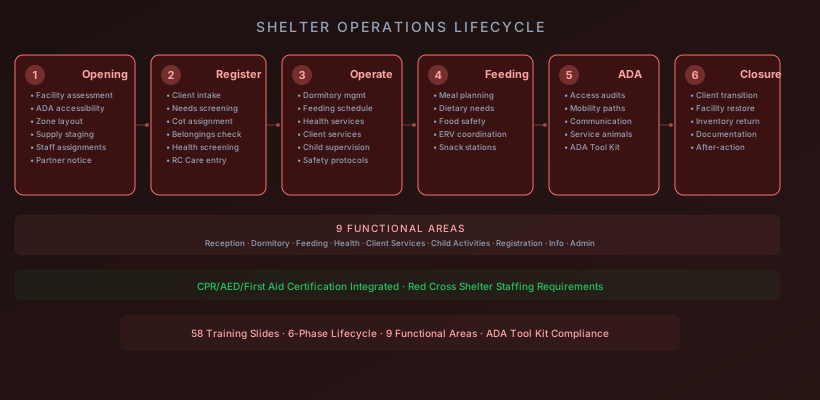
Mapped the complete shelter lifecycle across its six phases, then designed training around the 9 functional areas volunteers must master to operate a shelter safely and effectively.
Shelter Lifecycle Mapping
Analyzed the full sheltering cycle from the Red Cross operational framework: Opening, Organizing, Operating, Maintaining, Closing, and Follow-up. Identified the critical decisions, staffing requirements, and common failure points at each phase. This lifecycle became the structural backbone of the curriculum, ensuring volunteers understand not just individual tasks but how their work fits into the shelter's full operational arc.
Functional Area Design
Designed training modules for each of the 9 shelter functional areas: Reception, Registration, Dormitory, Feeding, Health Services, Client Services, Child Activities, Information, and Administration. Each module covers setup procedures, ongoing operations, and the transitions between shelter phases. Created cross-functional scenarios showing how areas must coordinate during peak intake periods and shift changes.
ADA Accessibility Integration
Built comprehensive ADA compliance training using the Red Cross ADA Tool Kit as the primary reference. Covered physical accessibility (wheelchair paths, accessible cots, bathroom modifications), communication accessibility (sign language resources, visual aids, multilingual materials), and service animal accommodation. Trained volunteers to conduct facility accessibility audits before opening and maintain compliance throughout operations.
CPR/AED/First Aid Certification Alignment
Integrated CPR/AED and First Aid certification into the training day by connecting clinical skills directly to shelter scenarios. Rather than teaching certification content in isolation, each skill is presented in the context of shelter emergencies volunteers may actually encounter: a client experiencing chest pain in the dormitory, a child with an allergic reaction in the feeding area, or a fall injury during setup. This contextual approach improves both skill retention and certification completion.
A 58-slide single-day training program designed to prepare volunteers to operate emergency shelters across all functional areas, with integrated CPR/AED/First Aid certification and ADA compliance training.
Progressive Shelter Setup Training
Training follows the actual shelter opening sequence: facility assessment, zone layout planning, supply staging, and staff assignment. Volunteers learn to evaluate buildings for shelter suitability, design functional zone layouts that maintain client flow, and prepare all 9 operational areas before the first client arrives.
Client Registration and Intake Protocols
Structured training on the registration process covering client identification, needs screening, health assessment, belongings check-in, and cot assignment. Emphasizes confidentiality protections and trauma-informed approaches when working with displaced families who may be in acute distress.
Dormitory and Feeding Management
Operational training for the two highest-volume shelter functions. Dormitory modules cover cot spacing requirements, privacy considerations, overnight safety monitoring, and quiet hours enforcement. Feeding modules address meal planning for diverse dietary needs, food safety and temperature control, ERV meal coordination, and snack station management between scheduled meals.
ADA Compliance and Accessibility Standards
Comprehensive accessibility training using the Red Cross ADA Tool Kit. Volunteers learn to audit facilities for physical barriers, create accessible pathways and sleeping areas, accommodate service animals, provide communication aids for clients with hearing or vision impairments, and maintain accessibility throughout the shelter's operational period.
Partner Agency Coordination
Training on coordinating with external partners including the Salvation Army (feeding support), local emergency management (facility and logistics), community organizations (donation management), and health departments (sanitation and health monitoring). Covers communication protocols, resource sharing agreements, and chain of command clarity.
Functional area cross-training prevents single points of failure
Teaching volunteers the basics of adjacent functional areas meant shelters could continue operating when specific roles went unstaffed during shift transitions.
ADA compliance training works best with concrete facility examples
Using photos of actual shelter locations to practice accessibility audits made the ADA Tool Kit standards tangible rather than abstract for volunteers.
58
Training Slides
9
Functional Areas Covered
6
Sheltering Cycle Phases
3
Certifications Integrated