disaster response
Curriculum DesignDistribution of Emergency Supplies in a Day
Single-day training curriculum for large-scale supply distribution operations covering ERV deployment and multi-agency coordination
48
Training Slides
3
Distribution Operation Types
5+
Partner Agencies
4
Supply Categories Managed
Prepare volunteers for large-scale supply distribution operations that activate when disaster events exceed individual DAT response capacity, requiring coordination with partner agencies, ERV mobile feeding units, and sustained inventory management across multiple distribution points.
- Distribution operations represent a scale-up from individual DAT responses, and many volunteers have no experience with large-scale logistics coordination
- ERV (Emergency Response Vehicle) operations involve food safety, route planning, and mobile service delivery that differ significantly from fixed-site distribution
- Comfort kit assembly requires knowledge of standard contents (hygiene items, clothing basics) and the ability to customize kits for families of varying sizes and needs
- Inventory management must balance speed of distribution with accurate tracking for resupply requests and operational reporting
- Multi-agency coordination with the Salvation Army, local emergency management, and community organizations requires clear communication protocols and chain of command understanding
- Distribution point operations must accommodate high client volumes while maintaining dignified, client-centered service delivery
Analyzed the three types of distribution operations (fixed-site, ERV mobile, and community distribution) and designed training that prepares volunteers for each model while emphasizing the multi-agency coordination that makes large-scale operations possible.
Distribution Operations Analysis
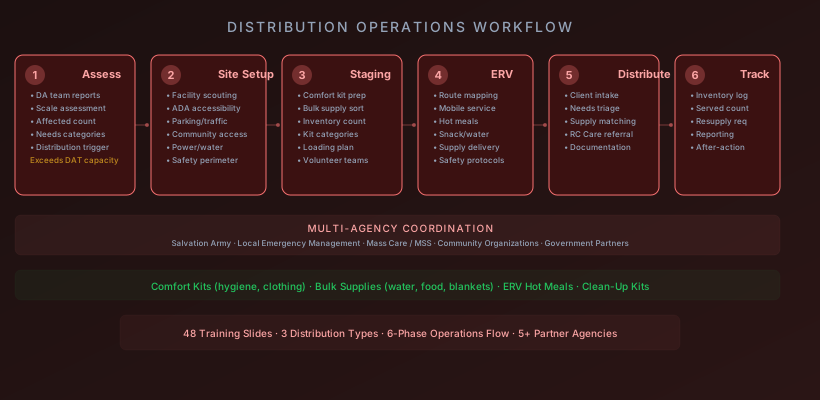
Mapped the three primary distribution models used in Red Cross disaster response: fixed-site distribution points where clients come to a central location, ERV mobile operations that bring supplies and meals to affected neighborhoods, and community distribution events coordinated with partner organizations. Identified the shared skills (inventory management, client intake, documentation) and model-specific competencies (ERV food safety, site layout design, partner coordination protocols) that the curriculum must address.
ERV Deployment Design
Created training modules specific to Emergency Response Vehicle operations. Covers vehicle orientation and equipment familiarization, route planning for maximum community coverage, hot meal preparation and food safety standards, snack and water distribution protocols, and coordination with fixed-site operations. ERV training emphasizes the mobile service model where the Red Cross brings relief directly to neighborhoods rather than requiring displaced families to travel to a central point.
Inventory Management Protocols
Designed supply chain training covering the full inventory lifecycle: receiving bulk supplies from regional warehouses, sorting and categorizing by type (hygiene, food, cleaning, comfort), assembling comfort kits with standardized contents, tracking distribution quantities, and generating resupply requests before stock runs out. Created inventory tracking templates and count reconciliation procedures that balance accuracy with operational speed.
Partner Coordination Training
Built multi-agency coordination training addressing the Salvation Army partnership (shared feeding operations, Statement of Understanding guidelines), local emergency management coordination (facility access, security, traffic management), community organization integration (donation management, volunteer surge), and Mass Care/MSS reporting requirements. Each partner relationship includes communication protocols, resource sharing procedures, and chain of command clarity.
A 48-slide single-day training program designed to prepare volunteers for all three types of distribution operations, with integrated ERV training, inventory management, and multi-agency coordination protocols.
Comfort Kit Assembly and Supply Management
Hands-on training for assembling standardized comfort kits containing personal hygiene items (toothbrush, toothpaste, soap, shampoo, deodorant), basic clothing items, and personal care supplies. Covers kit customization for family size, infant needs, and special requirements. Includes bulk supply sorting, storage organization, and kit assembly line efficiency for high-volume production.
Community Distribution Point Operations
Training on establishing and running fixed-site distribution points: site layout design for client flow, registration and intake procedures, needs assessment and supply matching, documentation for RC Care referral, and dignified service delivery that treats clients as people rather than numbers. Covers high-volume crowd management and queue design that respects client dignity.
ERV Mobile Operations
Comprehensive ERV training covering vehicle equipment orientation, hot meal preparation and food safety (temperature monitoring, serving protocols, allergen awareness), route planning for neighborhood coverage, mobile snack and water distribution, and coordination with fixed-site operations for supply replenishment. Prepares volunteers for the unique challenges of mobile service delivery.
Inventory Tracking and Resupply
Practical training on inventory management systems covering receiving and logging incoming supplies, distribution count tracking, daily inventory reconciliation, resupply request procedures, and reporting for operational summaries. Emphasizes the connection between accurate tracking and the ability to sustain operations across multiple days of distribution.
Multi-Agency Coordination
Training on working effectively with partner organizations during distribution operations. Covers Salvation Army coordination under Statement of Understanding guidelines, local emergency management facility and logistics support, community organization donation management, and Mass Care reporting. Includes communication templates, joint briefing procedures, and protocols for resolving resource conflicts between agencies.
Distribution scale-up is the hardest mental shift for DAT-trained volunteers
Adding a dedicated module on the transition from individual DAT responses to large-scale operations helped volunteers understand why distribution requires different workflows, partner coordination, and inventory discipline.
Client dignity must be explicitly trained, not assumed
Including specific training on dignified service delivery (eye contact, personalized interaction, choice-based distribution) prevented the depersonalization that can occur during high-volume operations.
48
Training Slides
3
Distribution Operation Types
5+
Partner Agencies
4
Supply Categories Managed