disaster response
DeliveredDAT Responder in a Day
Single-day immersive training preparing Red Cross volunteers for frontline disaster response
49
Training Slides
1 Day
Immersive Format
4
Core Response Phases
24/7
DAT Coverage Supported
Create a single-day immersive training that prepares volunteers to respond to any local disaster, whether house fires or flooding, with the skills to safely assess scenes, interview clients with care, document damage, and connect families with recovery resources.
- Volunteers come from diverse backgrounds with varying emergency response experience
- Training must cover on-scene operations: safety assessment, client intake, damage documentation, and case closure
- Safety-critical protocols require precise understanding because responders face real hazards like structural damage, smoke, and electrical risks
- Client interactions demand emotional intelligence: families may be traumatized, displaced, or grieving
- RC Care system must be mastered for real-time client intake and documentation
- The guiding principles of 'Clients First' and 'Get to Yes' must be internalized, not just memorized
DAT in a DAY
Agenda
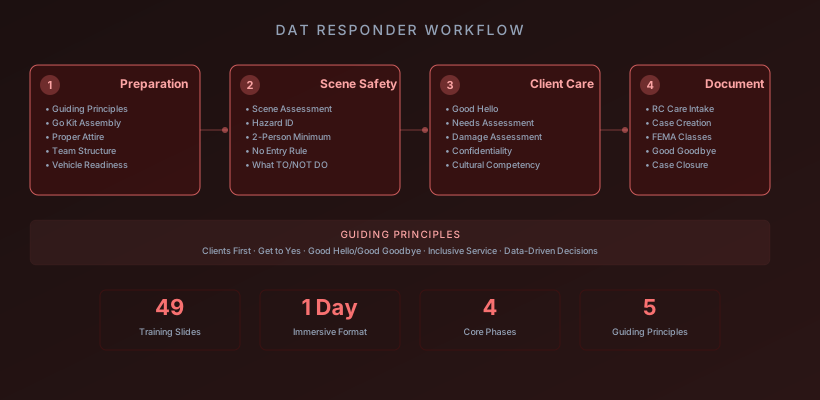
Structured the curriculum around the actual DAT responder workflow, building skills progressively from foundational concepts through hands-on application at each phase of on-scene disaster response.
Workflow Analysis
Mapped the complete DAT responder process from arrival on scene through case closure. Identified critical decision points, common failure modes, and the eight guiding principles that govern all disaster operations: Clients First, Inclusive Service Delivery, Care and Safety of the Workforce, Engaged Partnership, Good Hello/Good Goodbye, Get to Yes, Data-Driven Decision-Making, and Good Stewards of Donor Dollars.
Progressive Skill Sequencing
Organized the 49-slide curriculum to mirror the actual response sequence: foundational principles and team structure, then preparation (Go Kits, proper attire, vehicle readiness), then on-scene protocols (safety assessment, scene approach, hazard identification), and finally client-facing skills (interviewing, damage assessment, RC Care documentation).
Safety Protocol Integration
Embedded safety training throughout the curriculum rather than treating it as a standalone module. Responders learn the two-person minimum requirement, scene assessment protocols, and the critical importance of never entering damaged structures. Created clear 'What TO DO' and 'What NOT to do' reference materials for on-scene decision-making.
Client Care Program Training
Developed in-depth training on the Client Care Program including eligibility determination, damage assessment classifications, and the client intake process in RC Care. Emphasized interviewing techniques that maintain compassion while gathering required documentation, teaching responders to 'talk to the client, not your paperwork.'
A single-day immersive training structured around the actual disaster response workflow, preparing frontline volunteers to respond safely and with care to any local disaster.
Progressive Skill Building
Training flows from foundational concepts (guiding principles, team structure) through preparation (Go Kits, proper attire) to on-scene operations (safety, assessment, client care) and finally system mastery (RC Care documentation). Each section builds on the previous.
Client-Centered Interviewing Framework
Structured approach to client interactions covering initial contact ('Hi, my name is... I'm a volunteer with the Red Cross'), needs assessment, and maintaining confidentiality. Techniques address working with traumatized clients, children, and those with access and functional needs.
Detailed Damage Assessment Training
Clear FEMA-aligned classification system (Destroyed, Major Damage, Minor Damage, Affected) with visual examples and documentation requirements. Responders learn to accurately assess damage to determine Client Care Program eligibility.
Integrated Systems Training
Hands-on training with RC Care for client intake documentation. Responders learn to create client cases, record damage classifications, and generate proper confirmations for affected families.
Scale-Up Recognition
Training includes recognition of when events exceed DAT capacity and how to escalate to larger operations involving sheltering, mass feeding, or regional support activation.
Safety protocols must be embedded throughout, not siloed
Integrating safety reminders at each workflow phase rather than a standalone module improved on-scene safety compliance from day one.
Client interviewing skills require emotional context, not just procedures
Adding real-scenario narratives about displaced families helped volunteers internalize the 'Clients First' principle beyond memorization.
49
Training Slides
1 Day
Immersive Format
4
Core Response Phases
24/7
DAT Coverage Supported