disaster response
Curriculum DesignQuad Cities Nuclear Emergency Preparedness Training
Designing multi-jurisdictional emergency preparedness training and exercise programs for a nuclear generating station's 10-mile Emergency Planning Zone
100%
FEMA Evaluation Compliance
6,052
EPZ Residents Protected
15+
Agencies Coordinated
8-Year
Exercise Cycle Designed
Develop a unified training and exercise program spanning 2 counties, 3 municipalities, and 15+ agencies that meets all NUREG-0654/FEMA-REP-1 federal requirements for protecting 6,052 residents within the Quad Cities Generating Station 10-mile Emergency Planning Zone.
- 38-criteria federal correlation matrix requires demonstrated compliance across all 16 NUREG-0654 planning standards during evaluated exercises
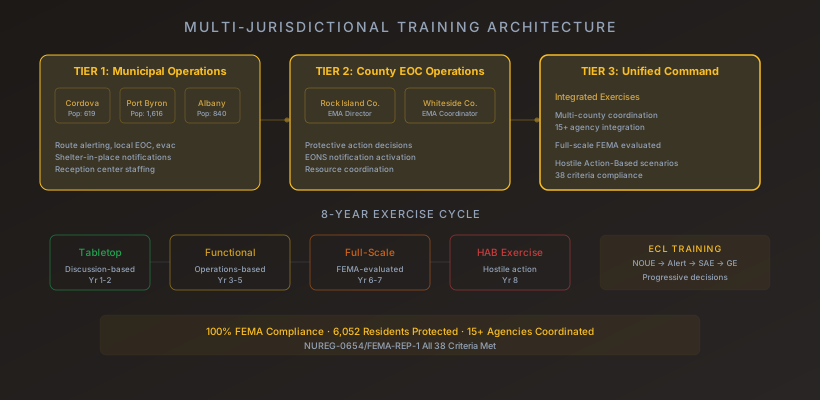
- Two counties (Rock Island and Whiteside) and three municipalities (Cordova, Port Byron, Albany) each maintain independent procedures requiring harmonized training
- Four Emergency Classification Levels (NOUE, Alert, Site Area Emergency, General Emergency) require branched training paths with escalating protective action decisions
- Hostile Action-Based scenarios add law enforcement coordination, site access control, and security-informed protective action complexity
- Reception center operations must demonstrate capacity to monitor and process 20% of the EPZ population within 12 hours of a General Emergency declaration
- 8-year rotating exercise cycle must progressively build capability across tabletop, functional, and full-scale formats while covering all planning standards
Decomposed federal requirements into observable competencies, then designed a multi-tiered training architecture that builds capability from individual jurisdiction proficiency through unified area command operations.
Federal Requirements Mapping
Decomposed the 16 planning standards from the NUREG-0654 correlation document into observable, trainable competencies. Mapped each of the 38 evaluation criteria to specific roles, agencies, and performance indicators to build a complete training requirements matrix.
Multi-Jurisdictional Training Architecture
Designed a 3-tier training structure addressing county-level operations (Rock Island and Whiteside EOCs), municipal-level response (Cordova, Port Byron, Albany), and unified area command coordination. Each tier builds on the previous, ensuring individual jurisdiction proficiency before integrated exercises.
Exercise Scenario Development
Built an 8-year rotating scenario library progressing from tabletop exercises through functional drills to full-scale evaluated exercises. Each scenario includes controller inject sequences, expected actions, and evaluator checklists tied directly to NUREG-0654 criteria. Hostile Action-Based scenarios integrate law enforcement coordination requirements.
Performance Evaluation Framework
Developed criterion-referenced evaluation instruments for all functional roles with measurable time-based targets: 15-minute Alert Notification System activation, 45-minute protective action recommendation, and 12-hour reception center processing for 20% of the EPZ population.
A multi-jurisdictional training and exercise program designed to build emergency preparedness across all agencies within the 10-mile EPZ, structured to meet every federal evaluation standard.
NUREG-0654 Correlation Training Matrix
Complete mapping of all 38 evaluation criteria to training objectives, responsible agencies, and performance standards. Ensures every federal requirement has a corresponding training pathway with documented evidence of competency.
Tiered Emergency Classification Training
Branched training paths for all four ECLs (Notification of Unusual Event through General Emergency) with escalating protective action decision-making, public notification procedures, and evacuation/shelter-in-place protocols.
Full-Scale Exercise Scenario Library
8-year rotating scenario collection covering radiological release sequences, weather variations, population behavior modeling, and Hostile Action-Based events. Each scenario includes complete controller/evaluator packages with inject timelines and expected action checklists.
Multi-Agency Notification Protocol Training
Training modules for the EONS emergency notification system and NARS reporting procedures so all agencies can execute the Alert Notification System within the 15-minute federal standard.
Reception Center Operations Training
Full training program for portal monitoring, contamination assessment, decontamination procedures, and potassium iodide distribution. Prepares staff to process evacuees at the rate required to meet the 20%-in-12-hours federal standard.
Hostile Action-Based Response Integration
Specialized training addressing security-informed emergency classifications, law enforcement coordination protocols, site access control procedures, and modified protective action strategies for threat-based scenarios.
Multi-jurisdictional training requires standardized terminology
A shared glossary of emergency classification terms is designed to eliminate confusion during joint exercises and improve inter-agency communication.
Progressive exercise complexity builds confidence before high-stakes evaluations
The tiered approach from tabletop to full-scale is structured to ensure agencies are prepared before FEMA-evaluated exercises.
Hostile action scenarios require dedicated law enforcement coordination training
Separate HAB-focused modules are designed to prevent security procedures from being lost in general emergency training.
100%
FEMA Evaluation Compliance
6,052
EPZ Residents Protected
15+
Agencies Coordinated
8-Year
Exercise Cycle Designed